
Rio Rancho, NM · Garage Door Service
How Rio Rancho's Winters and 1980s-Era Doors Work Against Each Other
Rio Rancho's 1968-1999 housing stock meets severe cold winters - here's what actually breaks each season, what homeowners really misjudge, and why it happens.
- Repairs & new doors
- Springs & openers
- Serving 4 nearby communities
Season by Season
Winter is the season that does the damage here. Rio Rancho sits in a climate band rated cold and severe, and that means real freeze-thaw cycling, not just a few cold mornings. A torsion spring that held steady tension all fall loses some of that tension as the metal contracts in a hard freeze, and on a door installed when the house went up - most of this area's stock dates to between 1968 and 1999, with the median build year at 1981 - that spring has had three or four decades of cycling behind it already. Cold makes it the final straw.
Spring brings the thaw, and with it, moisture working into track brackets and roller bearings that sat dry and stiff all winter. This is when rust shows up on steel track that wasn't wiped down before the cold hit.
Summer is the quiet season for most of these doors - expansion isn't the enemy here, contraction is - so it's the window to get ahead of the next winter rather than react to one.
Fall is prep season. Lubricating hinges and rollers before the first hard freeze, not after, makes the difference between a door that opens stiff in January and one that doesn't open at all.
What Local Conditions Do
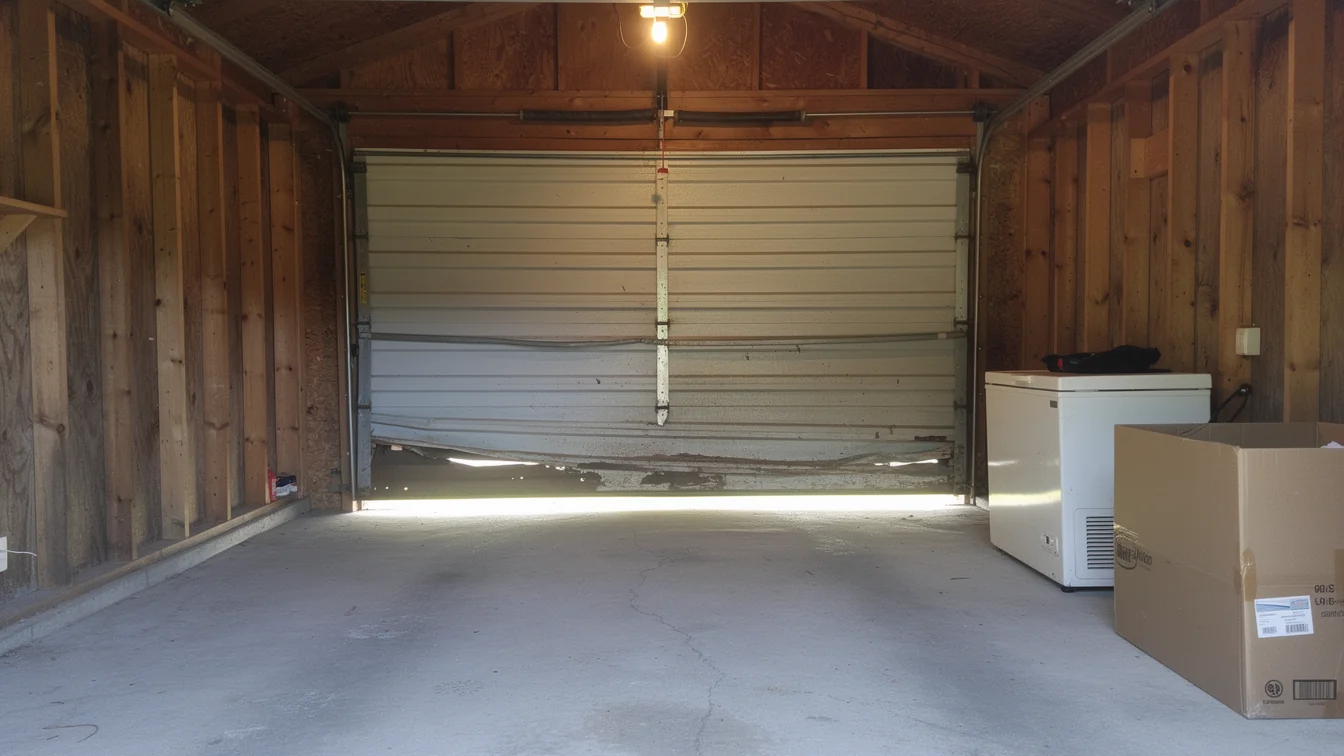
The cold-severe rating on this area isn't decoration - it's the reason steel garage door panels here see more cyclical stress than they would somewhere with a mild winter. Steel contracts in the cold, and a panel seam or weld that's fine at 70 degrees can show a hairline gap at 15. On a door from the 1980s or 90s, which describes most of what's standing across the ten named areas in this service territory, that seam has already flexed through thirty-plus winters.
The other piece is the hardware generation. A house built in 1981, the median year for this stock, was almost certainly fitted with a torsion spring system sized to the door weight standards of that era. Those springs weren't built to run forever, and cold tightens the tolerance on how much wear they can take before they snap rather than sag. We see more broken springs in the first hard-freeze week of the year than in any other stretch of the calendar, and it's not a coincidence tied to the weather alone - it's weather acting on hardware that's already near the end of its service life.
What Most People Get Wrong
The most common mistake is timing the maintenance to the wrong season. People lubricate hinges and rollers in spring, once things are already squeaking, instead of in fall before the cold sets the metal. By the time it's squeaking, the cold has already done its work on the spring tension too.
The second mistake is assuming a door that looks fine is fine. On houses built in the 1968-1999 range, insulation and seal standards were different from what's installed new today, and a door that's never been touched can be running on original weatherstripping that's cracked and brittle from decades of temperature swings. It still closes. It just isn't doing the job it was built to do.
The third is treating a spring replacement like a one-size job. A torsion spring sized for a door built under one era's weight and hardware standards isn't always a straight swap for a door from another era, even within the same house's build years. Guessing on spring size is how people end up back on the phone a few months later.
We'll say plainly: if the door is original to a house from the early part of that 1968-1999 window and the track is bent or rusted through, a repair is sometimes just delaying a replacement you'll pay for anyway.
What Is Going On
Put the pieces together and the pattern is pretty clear. This is an area with roughly 20,276 owner-occupied houses out of 30,505 households, most of them built between 1968 and 1999, sitting inside a climate band that cycles hard between freeze and thaw every winter. That combination means an unusually high share of garage door calls here are age-and-cold related rather than installation-defect related - the door didn't fail because it was built wrong, it's failing because thirty to forty winters of contraction have worn down a spring or a seal that was never going to last forever.
At a median household income of $65,432, most homeowners we talk to are making a practical call between fixing what's there and replacing it outright, not choosing the fanciest option on the shelf. For a door that's otherwise sound - track straight, panels unbent - a spring and weatherstripping job usually makes more sense than a full replacement. For a door where the track has rusted through or the panels have started separating at the seams, replacement stops being the expensive option and starts being the cheaper one over time.
Frequently asked questions
Why do garage door springs break more often in winter here?
Rio Rancho sits in a climate band rated cold and severe, and steel torsion springs lose tension as they contract in hard freezes. Combined with the fact that most houses here date to 1968-1999, a lot of springs are already decades old when the cold pushes them past their limit. That's why breaks cluster in the first hard-freeze stretch of the year.
Is my garage door's weatherstripping just original to the house?
It's possible. With median build year at 1981 across this area's housing stock, a door that's never had its seals replaced could be running on weatherstripping that's thirty-plus years old and brittle from repeated winter-summer cycling. It still closes, but it won't be sealing the way new weatherstripping does.
Should I repair or replace an older door?
It depends on what's wrong. If the spring or seals have failed but the track and panels are straight, a repair usually makes sense. If the track has rusted through or panels have separated at the seams - more common on doors from the earlier end of the 1968-1999 build range - replacement tends to cost less over time than repeated repairs.
When should I lubricate hinges and rollers?
Fall, before the first hard freeze, not spring once things are already squeaking. The cold-severe winters here tighten metal tolerances fast, and a dry hinge going into a hard freeze wears faster than one that's been lubricated ahead of it.
Related garage door services in Rio Rancho
More garage door guides
Book garage door service in Rio Rancho
Call now or request a quote - tell us what the door is doing and where you are.